
The Bright Future of Solar Energy in New York City Schools
BY: Mahdi Hamdar
City College Of New York
Writing for Engineering
Professor Davidow
Climate change is a huge deal right now, and we need to do something about it. One cool idea is to put solar panels on the rooftops of public schools in New York City. This project would help the environment, save money on energy bills, and teach kids about being green. Some people think it’s too expensive and complicated, but the benefits are totally worth it in the long run. That’s why New York State should use some of the $4.2 billion from the Bond Act to fund this project and make our schools better and more eco-friendly.
The need for renewable energy has gone up a lot recently, and people are debating the best ways to use these technologies. Some say that the upfront cost of solar panels and the practical problems are big downsides, but others believe the long-term savings and environmental benefits far outweigh these issues. I think schools should install solar panels because the benefits, like lower energy bills and a bigger focus on sustainability, are too good to pass up.
Financial Benefits
One of the biggest reasons to put solar panels on school rooftops is the money it can save. Schools spend a lot on electricity, and solar panels can help cut these costs. For example, the K-Solar program in New York has already helped many schools reduce their energy bills. According to NYC DCAS, the city has doubled its solar capacity in less than three years, showing that these projects are feasible and effective. This saved money can be used for other important things, like buying new books or improving school facilities. Plus, with the free energy advisory services from the New York Power Authority (NYPA), schools can easily figure out the best way to install and finance these panels. In the long run, the initial investment in solar panels pays off by lowering energy costs and freeing up funds for other educational needs.
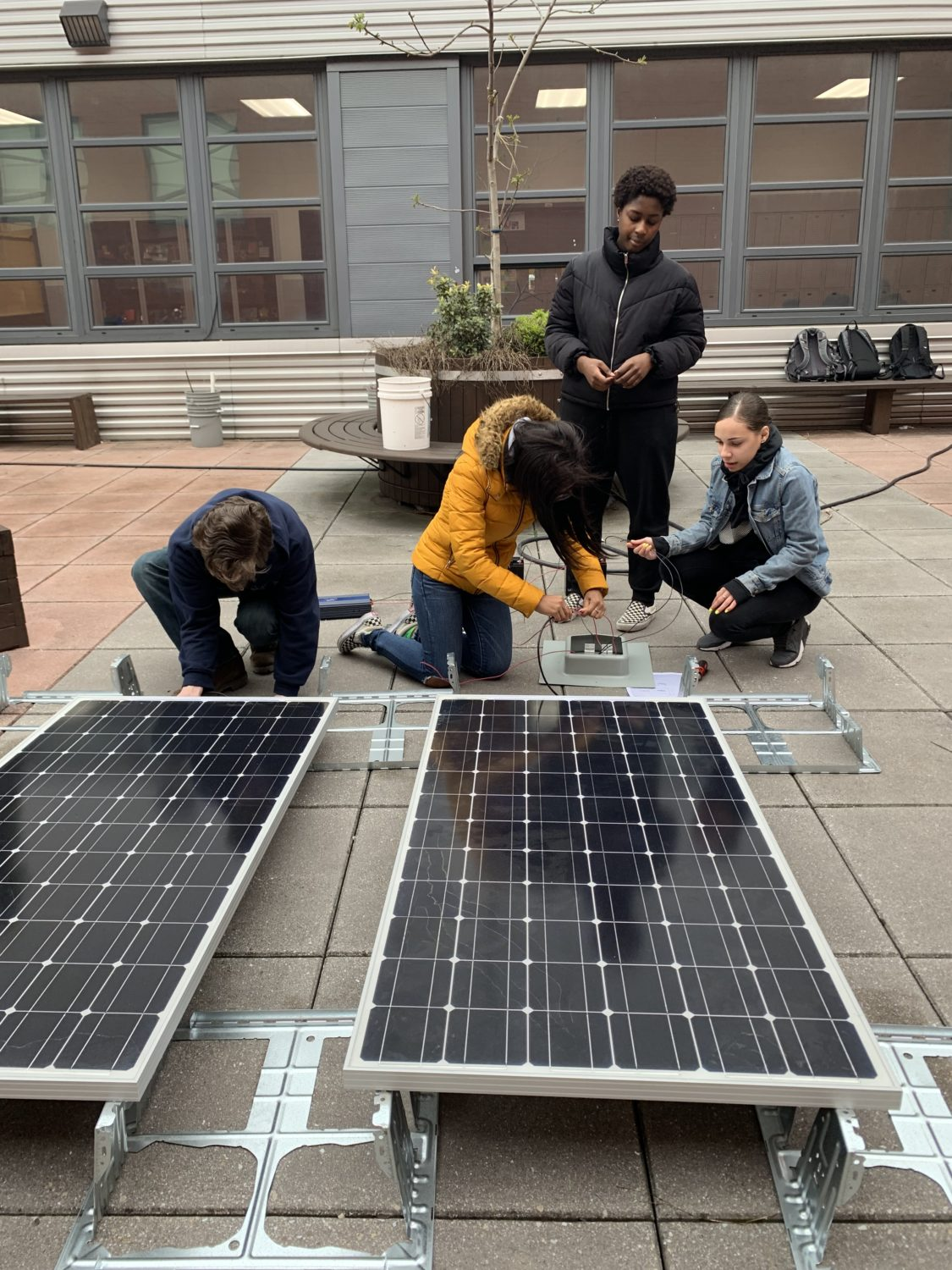

| Building Energy Exchange. (n.d.). NYC Solar Education Program [Photograph]. Retrieved May 26, 2024, from https://be-exchange.org/case_study/nyc-solar-education-program/ | Office of the Mayor. (2023). Mayor Adams Releases PlaNYC: Getting Sustainability Done [Photograph]. Retrieved May 26, 2024, from https://www.nyc.gov/office-of-the-mayor/news/274-23/mayor-adams-releases-planyc-getting-sustainability-done-new-york-city-s-strategic-climate-plan#/0 |
Environmental Benefits
The beneficial effects of renewable energy sources for the environment make it necessary to install them on public school roofs. A clean, renewable resource which reduces greenhouse gas emissions while also helping in the battle against climate change is solar power. Schools may significantly decrease their carbon footprint by installing solar panels. Using more renewable energy in schools contributes to environmental preservation and modernization of the electrical infrastructure. Not only does this benefit the environment, but it also serves as a fantastic model for pupils, emphasizing the value of sustainability and renewable energy. As to the NYC Department of Education, these installations provide students with direct knowledge of renewable energy, hence enhancing their comprehension and dedication towards environmental conservation.


| Inside Climate News. (2017). Solar Panels at School [Photograph]. Retrieved May 26, 2024, from https://insideclimatenews.org/news/29112017/solar-panels-school-science-education-clean-energy-rates-technology-stem/ | Sun Valley Solar Solutions. (n.d.). How Does Solar Work? [Illustration]. Retrieved May 26, 2024, from https://www.sunvalleysolar.com/blog/how-does-solar-wor |
Counter Argument
Some people think putting solar panels on school rooftops is just too expensive and complicated. They say the upfront costs are high and schools might have a hard time with the financing and installation. But programs like K-Solar are here to help. The New York Power Authority (NYPA) offers free energy advice to help schools see if solar energy is a good fit and to find financing options. Plus, the New York State Energy Research and Development Authority (NYSERDA) helps lower the costs through the NY-Sun Initiative. These resources make it easier and cheaper for schools to go solar. In the end, the long-term savings on energy bills and the benefits for the environment are totally worth the initial costs and challenges.
Conclusion
Conclusion Finally, installing solar panels on school rooftops in cities like New York is a wise and necessary step towards the future of sustainability. The benefits derived from improving the mix of renewable energy make it a great investment. Even though there are issues for the initial costs and logistics, support from programs like K Solar and NY Sun makes this project doable and of benefit. New York State should use some of the Bond Act funding for this, costing the institution less and protecting the environment, as well as teaching students about renewable energy. In so doing, we will have created a much greener and more sustainable future for all.
References
DCAS. (2023). NYC DCAS Doubles City’s Total Solar Capacity in Less Than Three Years. Retrieved from https://www.nyc.gov/site/dcas/news/23-011/nyc-dcas-doubles-city-s-total-solar-capacity-less-three-years-agreement-nypa
NYC Department of Education. (2023). NYC students learn about renewable energy through school rooftop solar panel installations. Retrieved from https://www.nydailynews.com/2022/02/09/nyc-students-learn-about-renewable-energy-through-school-rooftop-solar-panel-installations/
Stringer, S. M. (2023). Solar-powered schools could lead to rooftop revolution. Retrieved from https://www.amny.com/news/solar-powered-schools/
Cuomo, A. M. (2014, September 12). Solar power to reduce costs. Filipino Reporter, 42(41), 19–42.
<!–Additional Information:
Persistent link to this record (Permalink): http://ccny-proxy1.libr.ccny.cuny.edu/login?url=https://search.ebscohost.com/login.aspx?direct=true&db=f6h&AN=98171847&site=ehost-live
Reflection
Looking back at myself, I can say that my writing know-how and abilities of how to write have significantly improved. The appreciation of linguistic diversity has been a major area of growth. Collaborating with peers from different backgrounds enabled me to view my differences as assets. The various points of view bettered my own work and assisted me in growing a more sophisticated rhetorical sense. Improving my writing process techniques was another crucial lesson. I used to frequently disregard editing and rewriting because of viewed my initial draft as final before this course. But I’ve come to see writing as a multi-phase process that includes careful planning, rewriting, editing, and self-evaluation. Breaking down the writing process into these manageable steps has improved the quality of my work and boosted my confidence. I learned the value of teamwork through group projects and feedback from others. I got better at maintaining the expectations of the readers in my writing objectives, and this improved my understanding of different outlets and styles. All in all, the class has been life-changing. I’ve grown as an increasingly able and confident writer through engaging in collaborative writing, improving my writing process techniques, and getting a rhetorical sensibility. I have no doubt that these skills will come in helpful for my coming college and job assignments.

This entry is licensed under a Creative Commons Attribution-NonCommercial-ShareAlike 4.0 International license.

